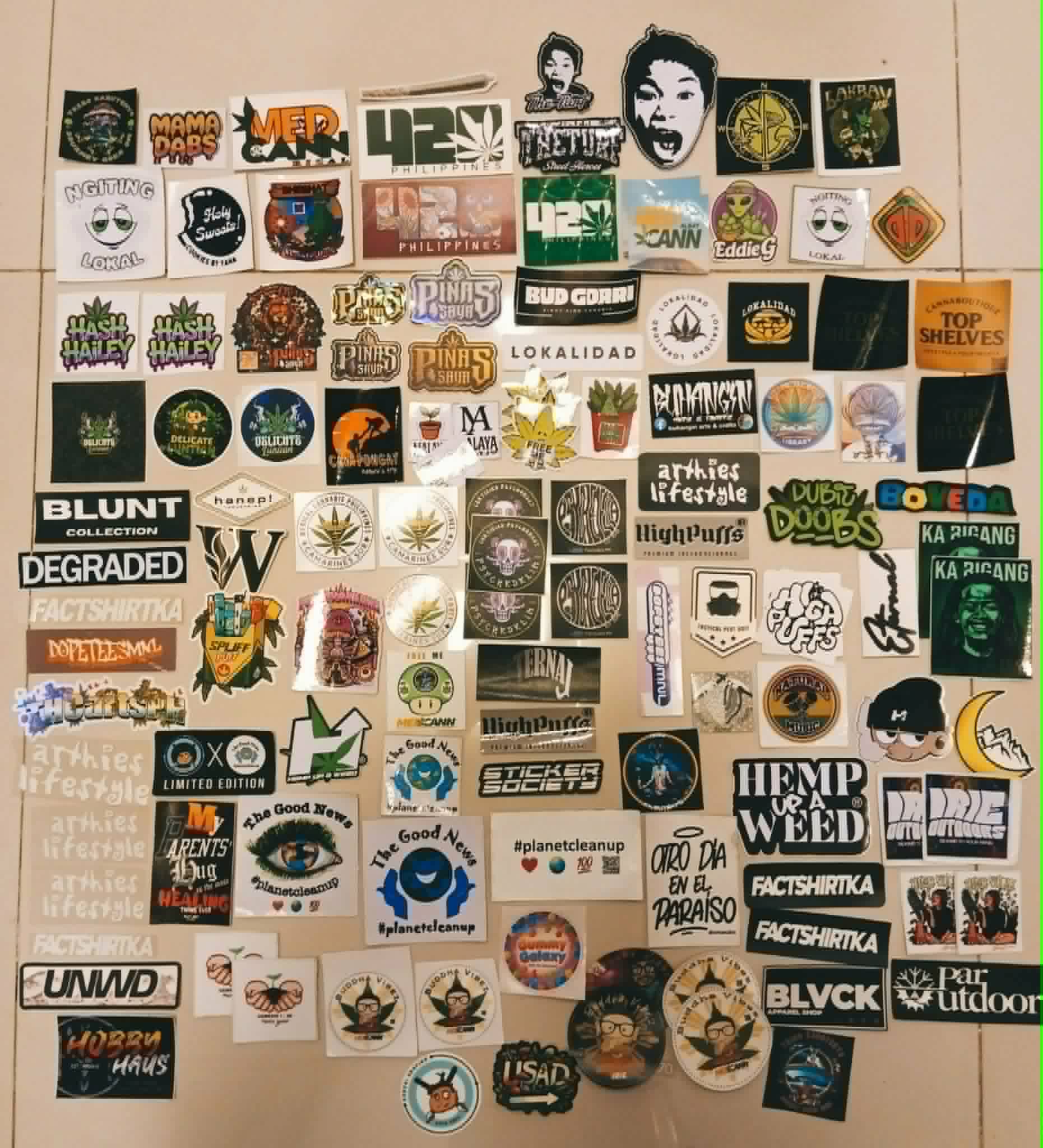
Where’d you stick it?
Where’d you stick it?
Within the community, there are connections that don’t require long-winded explanations—you just feel it in every exchange. The sticker is one of those things. It might be small, often just a freebie, but it carries weight. It’s not just an adhesive; it’s a piece of history and a badge of identity in a modern era that constantly tries to make us all look and act the same.
Art and Persona in Public Spaces
Every sticker has its own character and story. Sometimes, it’s just a minimalist, single-colored logo; other times, it’s complex and layered—full of symbols, messages of freedom, or inside jokes that only those “in the know” can decode.
This is portable art—a mini canvas that doesn’t need a grand gallery. According to art history, stickers are considered “post-graffiti.” While traditional graffiti requires time and spray paint, a sticker is instant. Seeing one on a street pole or on the back of a laptop in a coffee shop is enough to spark a quiet connection. Every piece of art we accept isn’t just decoration; it’s a representation of the principles and aesthetics we value within the community.
The Sticker Exchange as a Handshake
The sticker exchange is a fundamental part of the culture. Someone might hand you one at a big event, in the middle of a jam session, or it could come from a random friend who noticed your gear. This is our own version of a silent handshake—a simple signal that you belong here.
It’s like collecting Pokémon cards. There’s a sense of nostalgia in every trade, but instead of a children’s game, it’s the serious work of building an identity in the midst of a judgmental society. It’s about finding a sense of belonging—a way to claim your own space in the world. With every exchange, the network of people with the same vision expands.
Sticker Bombing: A Quiet Uprising
The concept of sticker bombing knows no boundaries. From the streets of New York in the ’70s to the corners of Manila today, the act of overlapping stickers until they form a collage is rooted in the art of graffiti.
When sticker bombing is brought into public spaces, it becomes a form of street activism. It may not always be “legal,” but it is art that fights against the boring, controlled nature of the city. It’s a reclamation of public spaces that are being slowly swallowed by giant billboards and corporate advertisements. “Postal Service stickers” (like Priority Mail labels in the US or simple barcode stickers here) have become favorite canvases for artists because they are free and fast to slap on—a clever way of using the system’s own resources to fight the system itself.
Every Sticker Is a Story of Resistance
At a gathering of advocates pushing for a more humane approach to cannabis, what stands out is how connections begin in something seemingly small. People meet for the first time through an exchange of stickers—immediately placed on notebooks, water bottles, or laptops. Sometimes there are nods instead of formal introductions, but these quiet gestures open the door to long conversations about lived experiences, health, advocacy, and issues that are often difficult to speak about freely outside the community.
In these moments, a sticker becomes more than design. It becomes a silent recognition of one another—a way of saying you are in a safe space, among people you can trust. Behind every piece of adhesive is learning drawn from personal experience, the sharing of life lessons, confronting stigma, and building relationships grounded in trust rather than judgment. Sometimes, a single sticker is enough to say: you do not have to face everything alone. These stickers also become a record of the people we’ve encountered and the ideas we’ve gathered from a community that chooses care over indifference.
It is not an official ID or membership card, but it serves as a quiet marker that in the midst of a chaotic and confusing world, there are people willing to relate, to share knowledge, and to walk alongside you. Stickers are not just exchanges of design, but exchanges of stories. One may come from someone who shared their experience as a patient. Another from someone who has survived difficult periods such as incarceration or mental depression. Another from someone who has only just found a space where they are not judged. Over coffee, during jam sessions, or seated in discussions, hidden stories emerge—conversations about healing, care, confronting prejudice, and moments where simply being heard becomes enough to be recognized as part of a community.
In this way, every sticker becomes a memory not only of an event, but of an experience that reminds us there is a community ready to support, listen, and learn with you.
Beyond Paper and Adhesive
This is not just decoration. Sticker culture is about an active commitment—to art, and to the life one chooses to live. Every sticker carries a story: of friendship, of sleepless nights, of lessons passed from one person to another, and of a culture that is repeatedly sidelined yet continues to stick, to persist, and to reappear.
You do not need a large platform to speak. Sometimes all it takes is strong adhesive and the courage to leave a trace.
In the end, a sticker is not only a mark of where you have been. It is also a mark of the people you have met, the stories that have left an imprint on you, and the convictions you have chosen to carry forward.
So the question returns: where did you stick it? And what story did you choose to carry with it? #


