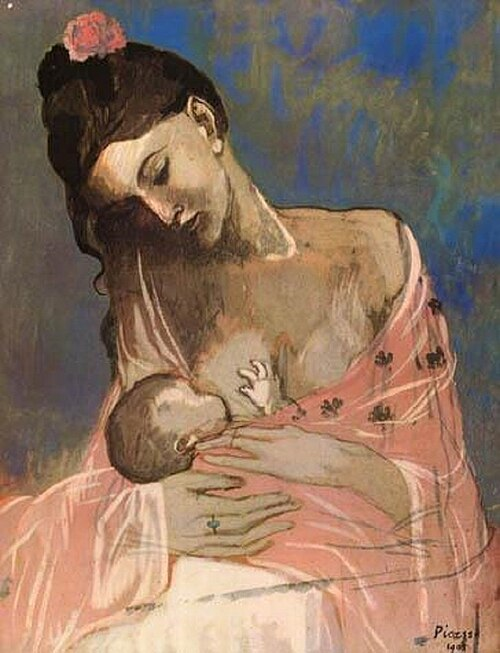
Pablo Picasso, 1905, Maternité (Mother and Child).
I didn’t find Tsang Weng on my own. She was given to me the way the most important introductions always are, by someone who already knew what I needed to see. Mama Dubs, my mother in this community, brought me to her. There are people you interview and people who hold the room. Tsang Weng is the second kind.
She speaks the way someone speaks when they have already been through the worst of it and survived. She does not speak with drama, but with a quiet certainty that is louder than anything. She is small in frame and enormous in presence. When she speaks about Gabriel, her youngest son, something in the air shifts. You feel it before you understand it.
That is who she is now. But that is not where she started.
Before cannabis, before the advocacy, before the Medical Cannabis Party and the Senate visits and the rallies and the medicine she carries to strangers, Tsang Weng was a simple woman living a simple life. Her world revolved around her children, her small family business, and the early mornings of someone who has learned that survival requires waking before the rest of the world does. She was a mother. That was enough.
Her youngest, Gabriel, was different from the start. She noticed things, such as the absence of eye contact, the stillness where there should have been movement, and the way he did not respond to his name. When the doctors finally gave it words, such as autism, ADHD, developmental delay, and epilepsy, she did not fall apart. She grabbed the diagnosis with both hands and ran toward it. She is that kind of woman.
What came closest to breaking her was what happened after.
Gabriel was put on pharmaceutical anti-epileptic medications. For a time, Tsang Weng followed every instruction. She trusted the system the way you trust a system when no one has yet given you a reason not to.
Then she watched her son begin to disappear.
His hair fell out. He stopped eating. He began hurting himself. He could not sleep. He could no longer walk. He was one year old, and the medicine meant to help him was pulling him further from the world he was already struggling to stay in.
She kept showing up at the hospitals. She kept asking questions. She kept searching for someone who could tell her what was happening to her child. She knocked on every door the system offered her. Every door was closed.
She had no community then. Her siblings did not know what to do, as she was the eldest who was supposed to have answers. Her own mother was always working. Gabriel’s father was absent, so she had to be both parents at once. She carried the full weight of a sick child while running a market stall before sunrise just to keep food on the table for her three sons.
She would wake at one in the morning, finish at noon, and ride home. She would come back to a child who needed everything from her, then do it all again.
Financially, the ground was always shifting beneath her feet. Every seizure meant an ER visit, every visit meant a bill, and every bill meant something else had to go, such as therapy or groceries. She did not have the luxury of falling apart.
For years, she lived in survival mode. It was the kind of survival that hollows a person from the inside if they let it. She did not let it.
As she tells me this, her voice begins to shake. There is a trembling underneath her words, which is not weakness, but the particular trembling of someone who has held something heavy for so long. She is not performing grief; she is revisiting it.
A tear travels down her face. In that one tear is every night she did not sleep and every moment she swallowed her fear so Gabriel would not feel it. The thought of going back to that place where there was no community or medicine is something she cannot fully contain, even now.
No mother should have to carry this alone. She found the plant through obsessive and relentless research. She scoured social media groups, read everything she could find, and messaged strangers until someone finally let her in.
Before she found any community, she had already begun her own quiet study. She tracked Gabriel’s seizures, dosages, and reactions. Out of sheer love, she became her own researcher, healer, and guide.
The babaylan, who was the keeper of plant knowledge in pre-colonial times, did not disappear. She lives in women like Tsang Weng, who refuse the idea that healing must come packaged in a prescription.
Tsang Weng found the medicine anyway. She joined the Philippine Cannabis Compassion Society, Sensible Philippines, and eventually MedCann. She was not just a member; she was a pillar. She had found her people.
The oil began to work in layers. First, the seizures began to space out. Then, Gabriel made real eye contact. He began to recognize her face, respond to sounds, and eventually learned to stand and run.
However, every seizure was a reset for Gabriel. It was months of his life taken away. So, Tsang Weng studied dosages herself and tapered his pharmaceutical medications carefully.
One day, Gabriel sang a children’s song to her. He still sings it when he wants to say he loves her. She pauses when she tells me this, and that pause holds everything.
Mommy Weng: From Private Struggle to Public Pillar
The community calls her Mommy Weng. She became this for others gradually, then completely. Families from across the country message her at night to ask questions they cannot ask their doctors.
She does not give medical advice. She shares her experience, which includes the years she spent learning Gabriel’s body and studying the plant. She speaks in front of people now at forums and hearings.
This is a woman who once had stage fright so paralyzing that she would tremble at the thought of a crowd. The people around her told her that she had a voice and that they believed in her. She stood up and told her story so that other families would know they are not alone.
The families who reach her are mostly from the grassroots. When one member of a family is sick, they are all sick. She has seen what access to the plant does for these families, such as the mother who can finally sleep or the father who can go back to work.
Tsang Weng tells these stories as evidence of what the plant can do. She has knocked on every door, including the Senate and the Department of Health. She is not asking politely anymore. She wants legalization and safe access for every family.
She laughs when she says she will still be rallying even when she is 80, but she means every word. Tsang Weng is one story, but she represents millions of parents who faced the same broken system.
Communities like this built something the system never offered, which is knowledge passed from person to person in the language of those who actually lived it. That is what Mama Dubs gave me when she brought me to Tsang Weng. It was an understanding that this community is built not on ideology, but on necessity and love.
After the interview, she taught me about clove. She spoke with the ease of someone who has tested this knowledge in life, not just a laboratory. She is a woman of deep, real, and embodied knowledge.
She is a babaylan living in modern times. She is proof that the ancestors never left, as they moved into the determined women who refused to let their children suffer while the system looked away.
I followed her advice, and weeks later, it is still living in me.
Tsang Weng is a member of MEDCANN Philippines and a grassroots patient advocate for medical cannabis. Her son Gabriel continues to make progress, and she is still fighting.



That’s a MiRaquel🥰